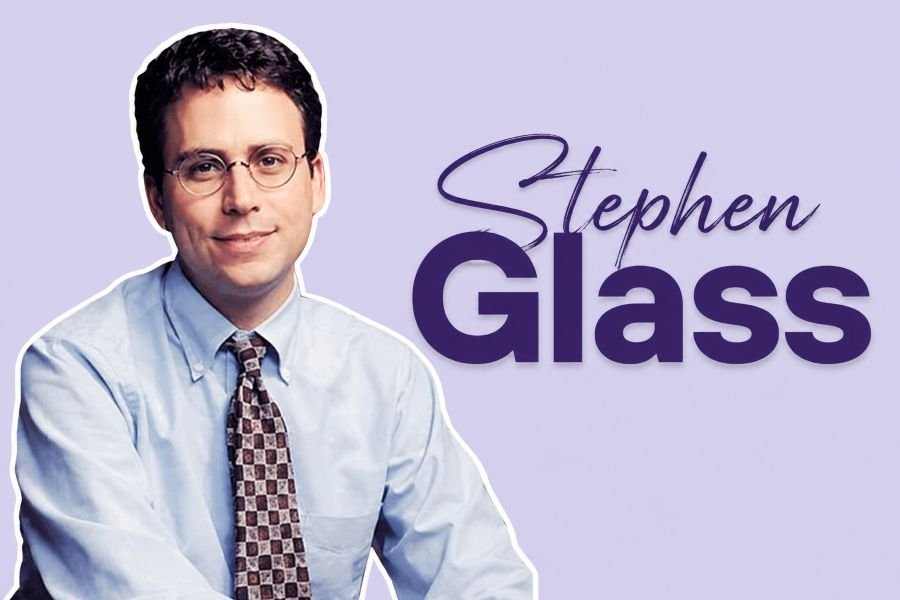
Stephen Glass Biography: A Shocking Fall in Journalism
Discover Stephen Glass’s early life, education, journalism scandal, legal career, book, personal life, and current professional role.

introdution
Stephen Glass is an American former journalist, writer, and legal-projects professional. He became widely known during the 1990s for writing colourful magazine stories for The New Republic and other leading publications.
His promising media career collapsed in 1998 when editors discovered that he had invented sources, quotations, people, companies, and events. His story later became one of the most discussed ethics cases in modern journalism.
Stephen Glass is best known for one of the biggest fabrication scandals in American magazine journalism.
Quick Bio
| Detail | Information |
|---|---|
| Full name | Stephen Randall Glass |
| Known as | Stephen Glass, Steve Glass |
| Date of birth | September 15, 1972 |
| Age | 53 years old as of June 2026 |
| Birthplace | Highland Park, Illinois, United States |
| Nationality | American |
| Profession | Former journalist, writer, and legal-projects professional |
| Education | University of Pennsylvania and Georgetown University Law Center |
| Famous for | Fabricating numerous magazine articles |
| Known book | The Fabulist |
| Wife | Julie Hilden |
| Current role | Director of Special Projects at Carpenter & Zuckerman |
| Attorney status | Not licensed to practise law |
Who Is Stephen Glass?
Stephen Randall Glass is a former American journalist whose career became a major warning about honesty, source verification, and editorial responsibility.
He worked at The New Republic between 1995 and 1998. During that period, he also contributed material to magazines such as Rolling Stone, George, Harper’s Magazine, and Policy Review.
Glass initially appeared to be a gifted young writer. His articles featured dramatic scenes, unusual characters, humour, and detailed dialogue.
However, many of those impressive details were invented. His case remains very different from the trusted work normally associated with professional American journalism.
Early Life and Family Background
Stephen Glass was born on September 15, 1972, in Highland Park, a suburb of Chicago, Illinois.
His father, Jeffrey Glass, worked as a gastroenterologist. His mother, Michele Glass, had a professional background in nursing.
He also grew up with a younger brother named Michael.
Glass attended Highland Park High School. During his school years, he became involved in student government, academic activities, and theatre production.
He worked behind the scenes on school performances and served as technical director for a student production group. These activities showed his early interest in creating scenes, stories, and organised presentations.
School Activities and Early Interests
Glass was an active student rather than someone focused on only one subject.
He participated in the National Honor Society and reportedly served as its vice president. He was also president of the Student Congress during his senior year.
His early interests included theatre, public affairs, politics, writing, and storytelling.
These skills later helped him create engaging magazine features. Unfortunately, the same creative ability was also used to build false characters and events.
University of Pennsylvania Education
After finishing high school, Glass attended the University of Pennsylvania.
He graduated in 1994 as a University Scholar, an academic programme designed for students interested in independent and interdisciplinary study.
While at university, he became deeply involved with The Daily Pennsylvanian, the institution’s student newspaper.
Glass eventually served as executive editor. His role gave him early experience in reporting, editing, newsroom management, and helping younger writers develop stories.
This period provided the foundation for his professional media career and introduced him to the standards expected in serious structured journalism.
Georgetown University Law Center
Glass originally planned to attend New York University School of Law after completing his undergraduate degree.
He postponed that plan when he received an opportunity to work in Washington journalism.
In 1997, while employed at The New Republic, he entered Georgetown University Law Center’s evening programme.
He completed his Juris Doctor degree in 2000 and graduated magna cum laude.
Glass was also selected as a John M. Olin student fellow in law and economics. His academic record showed that he remained a capable student despite the collapse of his journalism career.
Journalism Career Beginning
Glass began his professional career at Policy Review, which was then connected with the Heritage Foundation.
In September 1995, he joined The New Republic. He started with editorial and administrative responsibilities before advancing to feature writing and becoming an associate editor.
He was only in his early twenties when his articles began attracting attention.
His writing appeared lively, original, and filled with details that made readers feel present inside each scene.
At the same time, he was writing freelance pieces for other publications. This helped him build a reputation as a rising magazine writer and expanded his presence across political, cultural, and technology reporting.
Writing Style and Public Image
Glass developed a friendly and self-effacing public image inside the newsroom.
Colleagues remembered him as helpful, hardworking, polite, and eager to support other writers. He often appeared nervous about his work and asked colleagues to review his articles.
This behaviour created trust around him.
His articles usually featured entertaining characters, surprising situations, sharp dialogue, and memorable opening scenes.
Unlike a conventional journalist and author, Glass increasingly treated real-world reporting as if he were creating fiction.
How the Fabrications Began
Public court records state that Glass began inserting fabricated information into his work in 1996.
At first, some stories contained invented quotations, altered details, or false anonymous sources.
Over time, the dishonesty became more serious. He began creating people, organisations, events, documents, and sometimes almost complete stories.
Because Glass had previously worked with fact-checking systems, he understood how editors verified articles.
He used that knowledge to prepare false notes, fake business cards, invented voicemail accounts, fabricated documents, and misleading supporting material.
The “Hack Heaven” Article
The story that ended Glass’s journalism career was titled “Hack Heaven.”
It appeared in the May 18, 1998, edition of The New Republic. The article claimed that a 15-year-old computer hacker had broken into a software company’s system.
According to the story, the company later hired the teenager as a security consultant.
The company was called Jukt Micronics. However, it did not exist.
The article appeared convincing because it included supposed quotations, technical details, company information, and descriptions of a hackers’ convention.
How Stephen Glass Was Exposed
Adam Penenberg, a journalist working for Forbes Digital Tool, attempted to follow up on the “Hack Heaven” story.
He could not find reliable evidence that Jukt Micronics existed. He also failed to verify the people, events, and organisations described in the article.
Penenberg contacted The New Republic, leading editor Charles Lane to question Glass.
Glass initially defended the story and produced supporting material. He had created a fake website, false contact information, and other misleading evidence.
He even involved his brother in an attempt to make one fictional source appear genuine.
The investigation eventually proved that the article was fabricated. Glass was dismissed from The New Republic in May 1998.
The case became an early lesson in how false material could appear believable during the growth of digital journalism.
Scale of the Journalism Scandal
After “Hack Heaven” was exposed, The New Republic reviewed Glass’s previous work.
The investigation found fabricated material in a large number of the 42 articles connected with him at the magazine.
Later legal records described misconduct involving more than 40 pieces published across several outlets.
Some articles contained invented quotations or characters. Others were largely or completely fictional.
Publications including Rolling Stone, George, Policy Review, and Harper’s also reviewed work he had submitted to them.
The scandal was especially damaging because Glass had repeatedly deceived editors, fact checkers, colleagues, readers, and people mentioned in his stories.
False Documents and Sources
Glass did more than write false statements.
He produced detailed material designed to prevent his editors from discovering the truth.
This material included fake notes, invented phone numbers, false letterheads, voicemail accounts, business cards, and a basic website.
He also used anonymous or partly identified sources because they were difficult for fact checkers to contact independently.
His methods showed how a dishonest writer could exploit trust and weaknesses in an editorial system.
The scandal encouraged news organisations to strengthen verification methods, particularly for unnamed sources and unusual claims.
Legal Disputes and Retractions
Some of Glass’s fabricated articles made harmful claims about real people and organisations.
Drug Abuse Resistance Education, known as D.A.R.E., challenged statements in one of his pieces. The dispute resulted in a settlement, retraction, and payment toward the organisation’s legal expenses.
In 2015, Harper’s Magazine formally retracted his article “Prophets and Losses.”
Glass admitted that most of the article depended on fabricated information.
The retraction was particularly important because it was reported as the first formal retraction issued by Harper’s during its long publishing history.
Public Apology and Explanation
Glass gave a major television interview to 60 Minutes in 2003.
During the interview, he acknowledged that lying had become a repeated part of his professional life.
He explained that he wanted colleagues to admire him and enjoy his stories. The positive reactions he received encouraged him to continue producing increasingly dramatic fabrications.
Glass later wrote apology letters to journalists, editors, organisations, and people affected by his work.
He also spoke to some students and public groups about journalism ethics and the consequences of dishonesty.
Therapy and Attempted Rehabilitation
After losing his journalism career, Glass entered long-term therapy.
During later legal proceedings, he said therapy helped him understand his need for approval and his fear of disappointing other people.
Friends, professors, employers, and professional contacts later described him as helpful, caring, loyal, and hardworking.
However, the authorities responsible for reviewing his legal career required stronger proof of rehabilitation.
The question was not simply whether he had improved personally. Officials had to decide whether he had demonstrated the honesty and moral character required of a licensed lawyer.
Legal Career and Bar Applications
Glass passed the New York bar examination after graduating from Georgetown.
However, passing a bar examination does not automatically allow someone to practise law. Applicants must also complete a character-and-fitness review.
His New York application faced serious concerns because of the journalism scandal. He eventually withdrew it.
After moving to California, Glass passed the California bar examination and applied for admission there.
The case reached the state’s highest court. In 2014, the California Supreme Court decision rejected his application.
The court concluded that the evidence presented did not satisfy the demanding standard needed to prove rehabilitation and fitness to practise law.
Stephen Glass has therefore never become a licensed attorney.
Current Career and Professional Role
Glass joined Carpenter & Zuckerman in California in 2004.
As of June 2026, the firm’s official staff profile identifies him as Director of Special Projects.
The firm clearly states that he is not an attorney.
His work is connected with special projects and legal-support activities rather than independent legal representation.
This role represents his longest publicly documented professional position since leaving journalism.
Stephen Glass’s Book The Fabulist
In 2003, Glass published a novel titled The Fabulist.
The book follows a fictional magazine journalist whose career and personal behaviour closely resemble Glass’s own experiences.
It is often described as a fictionalised or semi-autobiographical treatment of his scandal.
Glass received significant public attention when the book was released. However, some former colleagues criticised the decision because they believed he was earning money from misconduct that had harmed other people.
The book remains his best-known published work outside his discredited journalism.
Shattered Glass Film
The Stephen Glass scandal inspired the 2003 film Shattered Glass.
The film was written and directed by Billy Ray.
Hayden Christensen played Stephen Glass, while Peter Sarsgaard portrayed editor Charles Lane.
The story focuses on Glass’s work at The New Republic, the publication of “Hack Heaven,” and the investigation that revealed his deception.
The film is still used in discussions about media ethics, editorial responsibility, workplace trust, and fact-checking.
Marriage to Julie Hilden
Stephen Glass was married to Julie Hilden, an American lawyer, writer, and legal commentator.
The couple had a long-term relationship before marrying in 2014.
Hilden was known for writing about law, free speech, and social issues. She also published novels and legal commentary.
She developed early-onset Alzheimer’s disease and died in March 2018 at the age of 49.
Glass helped care for her during her illness. Her obituary described him as her husband and long-term partner.
Public Image After the Scandal
Stephen Glass remains one of the most controversial figures in American journalism history.
Supporters of his rehabilitation have highlighted his later employment record, personal relationships, therapy, apologies, and assistance to legal clients.
Critics argue that his deception was too extensive and continued for too long to be treated as a single mistake.
His attempts to enter the legal profession also created debate about forgiveness, professional standards, and whether someone can fully rebuild trust after repeated dishonesty.
His public identity is still closely connected with fabrication, failed fact-checking systems, media responsibility, and professional ethics.
Stephen Glass Career Timeline
| Year | Major event |
|---|---|
| 1972 | Born in Highland Park, Illinois |
| 1994 | Graduated from the University of Pennsylvania |
| 1994 | Began working at Policy Review |
| 1995 | Joined The New Republic |
| 1996 | Began publishing fabricated material |
| 1997 | Entered Georgetown University Law Center |
| 1998 | “Hack Heaven” was exposed and Glass was fired |
| 2000 | Graduated magna cum laude from Georgetown Law |
| 2003 | Published The Fabulist |
| 2003 | The film Shattered Glass was released |
| 2004 | Joined Carpenter & Zuckerman |
| 2006 | Passed the California bar examination |
| 2014 | California Supreme Court denied his law application |
| 2015 | Harper’s retracted “Prophets and Losses” |
| 2018 | His wife, Julie Hilden, died |
| 2026 | Continued serving as Director of Special Projects |
Major Turning Points
The first major turning point in Glass’s life was his move from university journalism into professional magazine writing.
His second was the success of his entertaining articles, which brought attention and approval from colleagues.
The exposure of “Hack Heaven” in 1998 became the most important turning point. It ended his journalism career and led to a wider investigation of his published work.
Graduating from Georgetown Law marked an attempt to build a different professional future.
The rejection of his California bar application in 2014 confirmed that the effects of the journalism scandal would continue to influence his career many years later.
Legacy and Impact on Journalism
Stephen Glass’s legacy is mainly connected with media ethics.
His actions showed that detailed notes and supporting documents are not always reliable when the reporter has created the evidence.
The case also demonstrated the danger of depending heavily on anonymous sources without independent confirmation.
Editors and fact checkers learned that unusual stories require verification beyond documents supplied by the writer.
His story continues to be studied because it raises difficult questions about ambition, trust, deception, accountability, and redemption.
Interesting Facts About Stephen Glass
- His complete name is Stephen Randall Glass.
- He served as executive editor of his university newspaper.
- He graduated magna cum laude from Georgetown Law.
- He passed bar examinations but was never licensed as an attorney.
- “Hack Heaven” included a completely fictional technology company.
- He created false documents and a fake website to support the story.
- His scandal inspired the film Shattered Glass.
- His only widely known novel is The Fabulist.
- His present employer uses the name Steve Glass on its staff page.
- He has worked at Carpenter & Zuckerman since 2004.
Frequently Asked Questions
Who is Stephen Glass?
He is an American former journalist known for fabricating numerous magazine stories during the 1990s.
What is Stephen Glass’s full name?
His full name is Stephen Randall Glass.
How old is Stephen Glass?
He is 53 years old as of June 2026.
Where was Stephen Glass born?
He was born in Highland Park, Illinois, United States.
Why is Stephen Glass famous?
He became famous after many of his articles were found to contain invented people, quotations, events, and sources.
What was “Hack Heaven”?
It was a fabricated article about a teenage hacker and a fictional software company called Jukt Micronics.
Did Stephen Glass become a lawyer?
No. He passed bar examinations but was not approved to practise law.
What does Stephen Glass do now?
He is listed as Director of Special Projects at Carpenter & Zuckerman.
Conclusion
Stephen Glass experienced a rapid rise and a dramatic fall in American magazine journalism.
He had strong writing ability, an excellent academic record, and early professional success. However, repeated fabrication destroyed his credibility and ended his reporting career.
His later education and legal-support work show an attempt to create a different professional life. Even so, his name remains permanently connected with one of journalism’s most serious modern ethics scandals.
His story is a lasting reminder that engaging writing can never replace truth, evidence, and honest reporting.