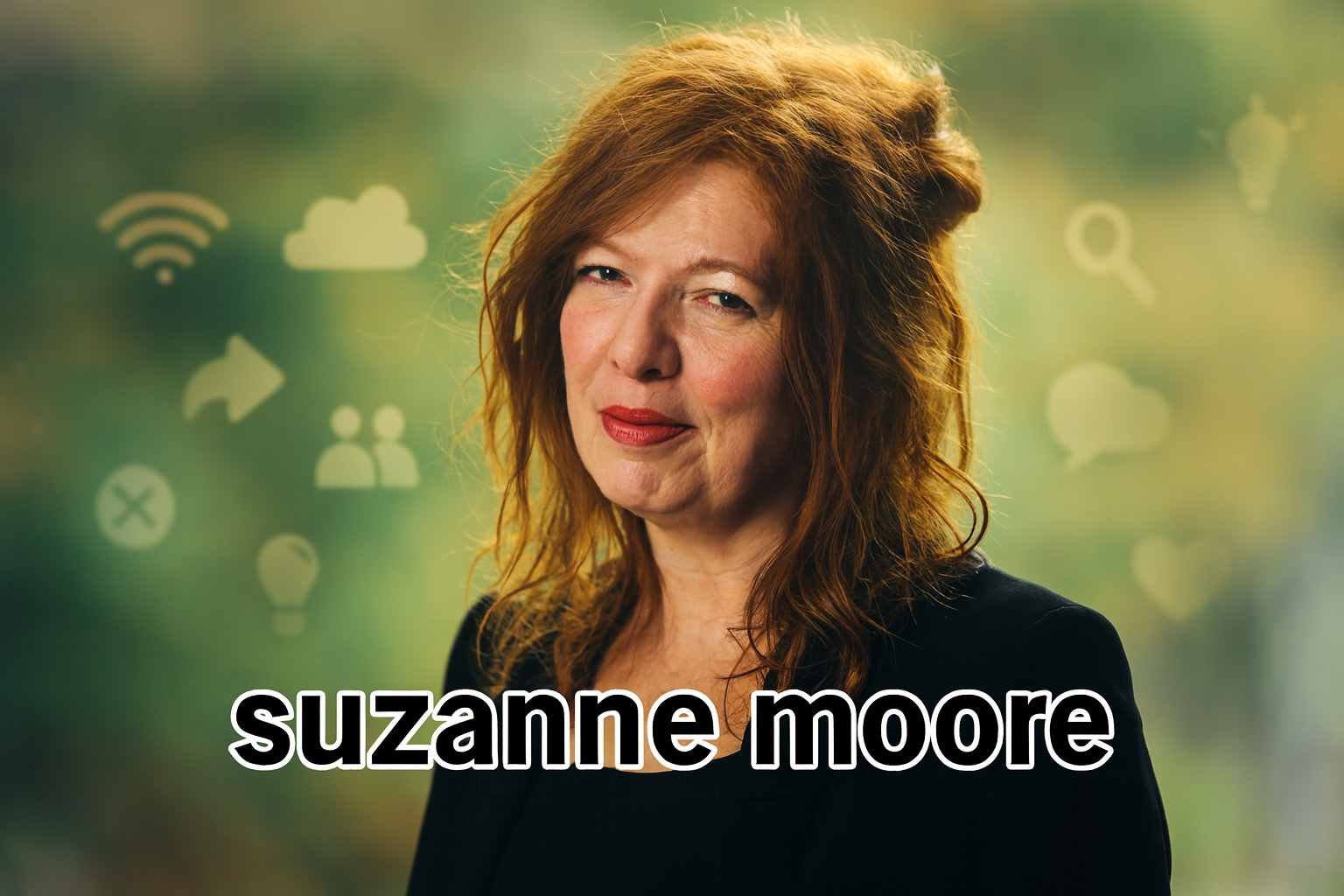
Suzanne Moore: Fearless Journalist Who Redefined Feminist Commentary in Modern Britain
The Untold Story of Courage, Controversy, and Cultural Impact

Table of Contents
ToggleIntroduction
Suzanne Moore is a renowned British journalist and columnist celebrated for her bold voice, fearless opinions, and unwavering dedication to truth in journalism. Known for challenging social norms and confronting sensitive issues with honesty, Moore has become one of Britain’s most respected and controversial media figures. Her career, marked by courage and authenticity, reflects the essence of independent journalism that dares to question power and ideology.
Born on July 17, 1958, in Ipswich, Suffolk, England, Suzanne Lynn Moore has spent decades shaping public debate through her thought-provoking writing. She stands as a symbol of integrity in media, consistently defending the freedom to think, speak, and write without compromise.
Quick Bio
| Full Name | Suzanne Lynn Moore |
|---|---|
| Date of Birth | July 17, 1958 |
| Age (2025) | 67 Years |
| Birthplace | Ipswich, Suffolk, England |
| Nationality | British |
| Education | Northgate Grammar School for Girls, Middlesex University |
| Profession | Journalist, Columnist, Commentator |
| Children | 3 Daughters |
| Residence | Hackney, London, UK |
| Award | 2019 Orwell Prize for Journalism |
| Affiliation | Patron, Humanists UK |
Early Life and Education
Suzanne Moore was raised in a working-class family in Ipswich, England. Her father was American, and her mother was British, giving her a diverse cultural background that would later shape her open-minded world view. From an early age, Moore displayed independence and intellectual curiosity. She left home at sixteen, determined to live on her own terms.
She attended Northgate Grammar School for Girls and later joined Middlesex Polytechnic (now Middlesex University), where she studied psychology before switching to cultural studies. Her academic background gave her a deep understanding of human behavior, society, and media — a foundation that would become central to her journalistic style. Although she began a PhD, Moore left before completion to pursue writing full-time, a decision that would change her life.
Start of Career and Rise to Prominence
Suzanne Moore began her career at Marxism Today, a magazine known for its innovative approach to politics and culture. She quickly gained attention for her intelligent and engaging commentary, balancing academic insight with a journalist’s instinct for storytelling. Her early work reflected a sharp understanding of gender, class, and culture — topics that would define her professional identity.
As her reputation grew, Moore began contributing to major British publications such as The Guardian, The Independent, The Mail on Sunday, The Telegraph, and The New Statesman. She became one of the few journalists able to discuss controversial issues like feminism, inequality, and free speech with honesty and empathy. Her fearless tone earned her both admirers and critics, making her one of the most talked-about journalists in the UK.
Achievements and Recognition
In 2019, Suzanne Moore received one of journalism’s highest honors — the Orwell Prize for Journalism. This award recognized her for producing bold, original, and socially conscious columns that challenged the status quo. Her writing stood out for its combination of emotional intelligence, cultural awareness, and political sharpness.
Moore’s work has appeared in some of the most influential publications in Britain. Her ability to provoke discussion while maintaining intellectual integrity has kept her relevant for decades. Whether writing about women’s rights, modern politics, or media censorship, her voice remains powerful, articulate, and deeply human.
Controversy and Departure from The Guardian
In 2020, Suzanne Moore published a column in The Guardian titled “Women Must Have the Right to Organise. We Will Not Be Silenced.” The article sparked widespread debate about gender and women’s spaces. Although it was praised by many feminists for defending women’s rights, others accused it of being insensitive toward transgender issues.
Following internal conflicts and public backlash, Moore announced her resignation from The Guardian in November 2020. Her departure became a defining moment in the ongoing conversation about freedom of expression and the limits of ideological conformity in modern media. Despite facing criticism, she refused to compromise her beliefs, reinforcing her reputation as a journalist who stands firmly by her principles.
Later Career and Current Work
After leaving The Guardian, Suzanne Moore continued her writing career with renewed independence. She became a contributor to The Telegraph and UnHerd, where she writes thought-provoking essays on politics, feminism, and cultural change. Her columns continue to question social assumptions, especially around women’s identity, class, and liberty.
As a patron of Humanists UK, Moore promotes rational thinking, secularism, and compassion in public life. She also remains active in media discussions about journalistic ethics, freedom of speech, and the responsibility of writers in shaping national debates.
Writing Style and Influence
Suzanne Moore’s writing style combines clarity, emotion, and fearlessness. She avoids jargon and speaks directly to the reader, often blending personal reflection with sharp political critique. Her work resonates with both academic readers and everyday audiences because she writes from lived experience, not just observation.
As a journalist, she has influenced generations of women writers who see her as a model of honesty and courage. Her career proves that journalism is not just about reporting facts — it’s about expressing truth with humanity and conviction.
Legacy and Impact
Suzanne Moore’s legacy lies in her refusal to be silenced. She represents a generation of journalists who believe in free thought, evidence-based reasoning, and integrity above popularity. Her contribution to feminist discourse, media freedom, and political commentary continues to shape how British journalism approaches gender and speech.
Through decades of work, she has proven that journalism can be both personal and universal — that truth, when spoken bravely, has the power to inspire change. In an age of polarized politics and digital noise, Suzanne Moore remains a rare voice of authenticity.
Conclusion
Suzanne Moore stands as a beacon of resilience in the world of journalism. Her journey from a working-class upbringing in Ipswich to becoming one of the UK’s most influential columnists is a story of determination, intelligence, and courage. Despite facing criticism and controversy, she has never wavered from her mission to write honestly and fearlessly.
As she continues her work today, Suzanne Moore remains not just a journalist but a cultural force — a reminder that truth-telling, even when uncomfortable, is the foundation of a free and fair society.
FAQs
Q1: Who is Suzanne Moore?
Suzanne Moore is a British journalist and columnist known for her outspoken views on feminism, politics, and culture.
Q2: What is Suzanne Moore’s nationality?
She is British, born in Ipswich, Suffolk, England.
Q3: What award did Suzanne Moore win?
She won the 2019 Orwell Prize for Journalism for her exceptional writing and commentary.
Q4: Where does Suzanne Moore currently write?
She writes for The Telegraph, UnHerd, and other independent media outlets.
Q5: What is Suzanne Moore known for?
She is known for her fearless commentary on women’s rights, social inequality, and media freedom, making her one of the most influential journalists in Britain.